.jpg)
Art at Gayles
Gayles has long been a place that draws out people’s creativity. It's been home to artists, writers, architects, photographers, painters, musicians, and sculptors, each responding in their own way to its atmosphere. Creative minds that include Duncan Grant, Millet, Lewis Carol and Edward Maufe to name a few. It's a place that offers the time and space needed for ideas to settle and take shape.
Gayles has long been a place that draws out people’s creativity. Over the years, it has been home to artists, writers, architects, photographers, painters, musicians, and sculptors, each responding in their own way to its atmosphere. Some of them have been well known; Duncan Grant, Millet, Lewis Carol and Edward Maufe to name a few. For many, it is a place that offers the time and space needed for ideas to settle and take shape.
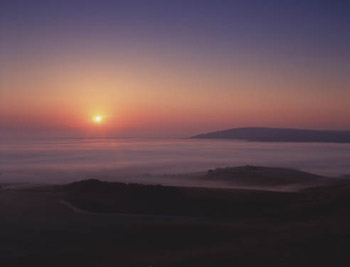
There is something about the setting that seems to lend itself to this. The light is special; brightened and softened by the close proximity of the sea, changing constantly across the Downs with the passing clouds, while the dawns and dusks can be absolutely stunning. The openness of the land, the wind, the quieter pace of life, and the presence of the sea breeze moving in from the coast all contribute to this feeling. Gayles sits on a hill surrounded by valleys, making it feel closely connected to the elements. In that sense, it offers a kind of creative space that is increasingly hard to find in today’s world: somewhere to step back, reflect, and think more clearly.
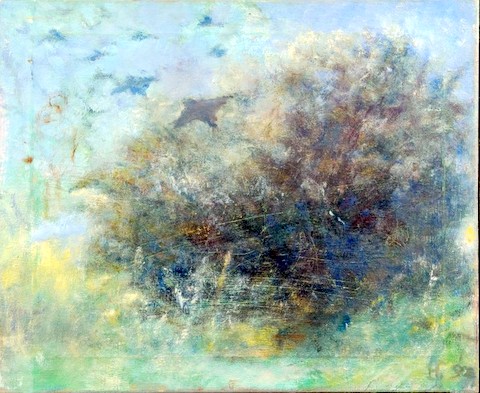
Some of the art created at Gayles is still present in the house and surrounding buildings. Many of the paintings you see are by Roz’s mother, Helen Stutchbury, who lived at Gayles for many years. She was well respected nationally and her work remains an important part of the atmosphere here and many of her pieces can be found in the accommodation and houses. They feel like part of the fabric of the spaces.
Derry, who now runs the retreats alongside Roz and cooks during them, is also a landscape photographer. In the 1980s, he became well known for his work, much of which focused on the surrounding Sussex countryside, including the Seven Sisters Cliffs, Beachy Head, Cuckmere Valley, and the wider South Downs. If you look around the accommodation and buildings at Gayles, many of the landscape photographs you see were taken by him.
There are also quiet echoes of creativity throughout the gardens, meadows, and orchard. Small statues and objects have become part of the land and its atmosphere. The origins of some of them are unknown, placed there long ago by relatives of Roz. The people who have lived at Gayles have often expressed themselves through the land, leaving quiet marks that have become part of the place over time.
For some, being in this kind of environment brings attention back to a creative side of themselves. It lets the mind wander to places often closed off by the routines and pressures of day-to-day life. The combination of silence, time, landscape, and the footsteps of those who have come before creates space for creativity, reflection, and observation, often bringing back a spark that many people have not felt for a long time.
QUESTIONS
Can I spend time on my own to think or create?
Yes. Alongside the structured parts of the retreat, there is space to be on your own. Some people use that time creatively, others simply rest or walk.
Is this suitable for writers or people looking for inspiration?
For many people, yes. While it is not designed specifically as a writing or creative retreat, the quiet and the setting often provide the kind of space that supports that.
Can guests see the art during their stay?
Yes. Artworks, photographs, sculptures, and small objects can be found throughout the houses, accommodation, gardens and grounds, please be mindful of other guests though.
more stories
Heading
Lorem ipsum dolor sit amet, consectetur adipiscing elit. Suspendisse varius enim in eros elementum tristique. Duis cursus, mi quis viverra ornare, eros dolor interdum nulla, ut commodo diam libero vitae erat. Aenean faucibus nibh et justo cursus id rutrum lorem imperdiet. Nunc ut sem vitae risus tristique posuere.
.jpg)
Heading
Lorem ipsum dolor sit amet, consectetur adipiscing elit. Suspendisse varius enim in eros elementum tristique. Duis cursus, mi quis viverra ornare, eros dolor interdum nulla, ut commodo diam libero vitae erat. Aenean faucibus nibh et justo cursus id rutrum lorem imperdiet. Nunc ut sem vitae risus tristique posuere.
Heading
Lorem ipsum dolor sit amet, consectetur adipiscing elit. Suspendisse varius enim in eros elementum tristique. Duis cursus, mi quis viverra ornare, eros dolor interdum nulla, ut commodo diam libero vitae erat. Aenean faucibus nibh et justo cursus id rutrum lorem imperdiet. Nunc ut sem vitae risus tristique posuere.
Heading
Lorem ipsum dolor sit amet, consectetur adipiscing elit. Suspendisse varius enim in eros elementum tristique. Duis cursus, mi quis viverra ornare, eros dolor interdum nulla, ut commodo diam libero vitae erat. Aenean faucibus nibh et justo cursus id rutrum lorem imperdiet. Nunc ut sem vitae risus tristique posuere.
UPCOMING RESIDENTIAL AND DAY RETREATS